
RPA and AI Are Not the Same Thing. Why the Difference Matters for Title Companies.


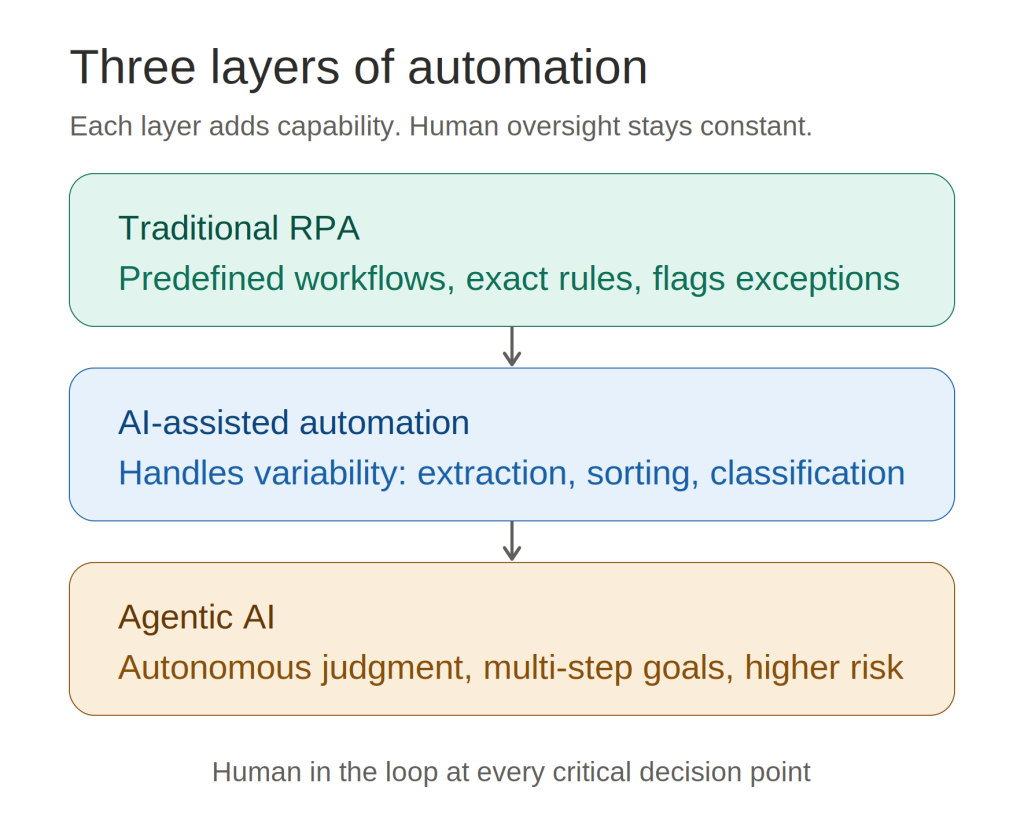
RPA and AI get filed under a single word in the title industry, where automation covers everything from macros to fully autonomous systems. The word “automation” gets thrown around in the title industry as if it covers everything from a macro in Excel to a fully autonomous AI system. It does not. And when title companies buy automation without understanding the distinction between RPA and AI, they often end up with a solution that works for part of the process and falls apart the moment the work requires judgment.
At TrueFocus Automation, we have spent years building and refining automation for title search workflows, and the clearest lesson is this: RPA and AI each have a lane. When they work together, the results are compelling. When one is used where the other belongs, the process breaks.
What RPA Is Actually Doing in a Title Search
Robotic Process Automation (RPA) handles the rules-based, repetitive steps. In a title search workflow, that means going to county recorder websites, logging in with credentials, running name searches, pulling assessor and tax records, and downloading the relevant documents. These steps follow a consistent pattern. The bot does not need to make a judgment call. It needs to execute a defined sequence reliably, at volume, and without fatigue.
That is where RPA excels. It does not get tired after running the same search 200 times. It does not miss a tab or forget to clear a field. For the retrieval layer of title search, RPA is the right tool.
Where AI Takes Over
Once the bot downloads the documents, the character of the work changes. A human examiner looking at a stack of retrieved records has to answer a judgment question: which of these documents actually applies to this property?
Some documents will be a direct hit. Others will match the name being searched but belong to a different property entirely. Sorting those out requires contextual understanding, not rules-based execution.
This is the layer where AI earns its place in our Title Hunter® and Title Miner® workflows.
- AI takes the documents the bot retrieved and categorizes them.
- It identifies which records are relevant to the subject property and which are false matches.
- It also handles data extraction, reading the documents, and pulling the information needed to prepare the commitment report.
The result is that what used to take roughly 60 minutes now takes 20-30 minutes. Instead of one file per hour, an examiner can move through two or more. The human is still in the loop, reviewing what the system surfaces, but retrieval and initial sorting now take almost none of that time.
Why the Distinction Matters When You Are Evaluating Vendors
Why the Distinction Between RPA and AI Matters When Evaluating Vendors
If a vendor describes their product simply as “AI-powered title automation,” ask them to be specific. What is the AI doing, and what is the RPA doing?
Vendors who lack operational background in the title industry tend to see the workflow as a single automation problem. They reach for AI because it sounds more capable, or they reach for RPA because it is cheaper, and they apply one tool across a process that actually requires both. Industry groups like the American Land Title Association have pushed members toward clearer standards as these tools spread, which makes a specific answer from a vendor a reasonable thing to expect.
The handoff between RPA and AI in a title search workflow is not a design detail. It is the reason the workflow produces reliable output instead of a pile of documents someone still has to sort manually. Understanding where rules-based execution ends and where document intelligence begins is the difference between automation that reduces examiner workload and automation that creates new problems at a different point in the process.
You can review how we approach title search and related workflows on our case studies page.
Jimmy Lewis is the CEO and Co-founder of TrueFocus Automation, a specialist in RPA and AI-driven workflow automation for the title insurance, mortgage, and real estate industries. TrueFocus has developed 840+ automation bots supporting more than 2,500 workflows and has returned over 1.3 million production hours to clients.