
Automation Readiness: Three Questions That Determine If It Will Actually Work for You


Automation readiness is the question most title companies skip. They start with the technology, asking “Should we use AI or RPA?” before answering the more fundamental question: is this process actually ready to automate?
After building over 840 bots, we’ve learned that successful automation projects answer three critical questions before a single line of code gets written. Miss any one of them, and you’re setting yourself up for an expensive failed deployment.
Question 1: Does the Economic ROI Make Sense?
This isn’t just “will it save money?” It’s about specific, measurable economics and realistic timelines.
What we actually need to know:
- What are your current monthly volumes, and what growth are you anticipating over the next 24 months?
- How much manual time is spent completing this process today?
- What’s the fully loaded labor cost for that time?
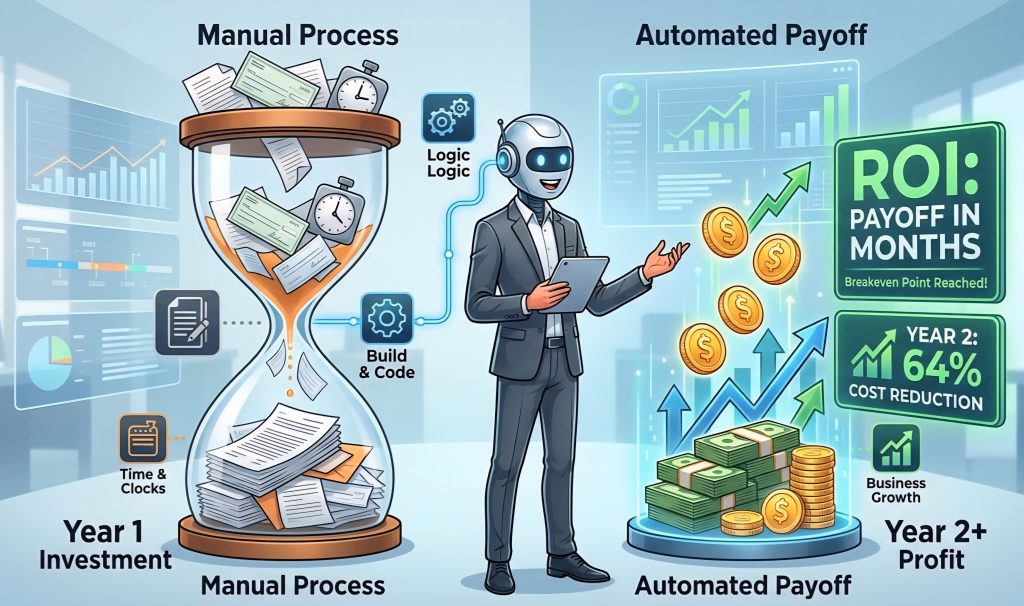
Here’s the threshold that matters: We look for processes requiring at least 0.5 to 1.0 Full Time Equivalent (FTE) of manual work.
Why? With an average build cost of $9,500 and annual maintenance/change requests around $8,000 to $10,000, a 0.5 FTE reduction is the minimum threshold for achieving ROI within 12 months.
If the process only consumes 10 hours per month of labor, automation might technically be possible, but the economics don’t work. You’ll spend more building and maintaining the bot than you’ll save in labor costs. There are some exceptions, but this holds true for most automation projects.
The “Success Tax” Factor
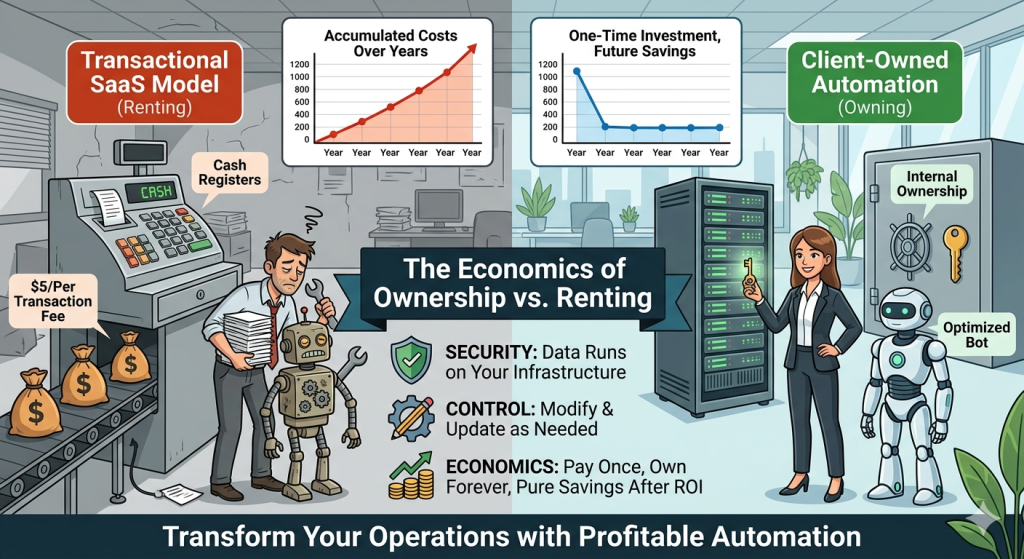
Here’s the question most companies forget to ask: if your volume doubles next year, would you prefer a fixed maintenance cost or a SaaS model where your fees increase with every transaction?
Growth should reduce your per-unit costs, not increase them. If automation makes you more expensive as you scale, something’s wrong with the model.
Question 2: Is Your Technical Foundation Ready?
Automation doesn’t exist in a vacuum. It must integrate with your actual systems, your actual data, your actual workflows, and your actual team’s capabilities.
Core Systems Assessment
Which Title Production System (TPS) are you using today? Do you expect any platform changes within the next year?
This matters because if you’re planning to migrate from SoftPro to ResWare in six months, building automation on top of your current system is premature. We’ll either need to wait or build something flexible enough to survive the transition.
Process Standardization
Is the process performed the same way every time, or do different people do it differently?
This is where most automation projects quietly fail. For instance, if four examiners follow four different workflows, automation amplifies the chaos instead of fixing it. Bots need a single, repeatable process to follow. If yours doesn’t exist yet, that’s the work to do first, and it’s worth doing whether you automate or not.
Data Quality
What does the input data look like, and how clean is it?
Automation runs on data. If your inputs are inconsistent, mislabeled, or live in three different systems with three different formats, the bot will faithfully process bad data into bad output, just faster. Before we build, we need to understand what the bot will be reading, where it comes from, and how often it’s wrong. Sometimes the right first step is a small data cleanup project, not a bot.
Hosting Preferences
Does the solution need to be hosted in-house on your servers, or are you comfortable with a vendor-managed cloud environment?
Enterprise clients often have security requirements that mandate on-premises or private cloud hosting. Smaller operations might prefer fully managed solutions. There’s no right answer, but we need to know before we architect the solution.
Support Resources
Do you have in-house IT capacity and expertise to support automation technology, or do you require a fully managed service?
Some clients have dedicated IT teams who want full control and visibility. Others need us to handle everything from deployment to monitoring to exception handling. Both models work, but they’re structured completely differently.
Question 3: How Much Strategic Control Do You Need?
This is where ownership models, IP considerations, and long-term flexibility come into play.
Asset Ownership
How important is it for your firm to own the Intellectual Property (IP) and the underlying code of your automation?
For some companies, this doesn’t matter much. For others, especially enterprise operations or firms in regulated environments, code ownership may be non-negotiable. They want the bots on their infrastructure, the code in their repository, and complete control over updates and modifications.
Customization Needs
Are there specific edge cases in your workflow that require a custom build rather than an out-of-the-box SaaS solution?
Every title company has quirks. County-specific requirements. Client-specific reporting formats. Integration points with proprietary systems. If your process has a lot of these, you need custom automation that can handle the exceptions, not a one-size-fits-all platform.
Maintenance Priority
How much control do you need over the timing of updates or changes to the automation logic?
Some companies are fine with vendors pushing updates on their schedule. Others need to control exactly when and how changes happen, especially if automation ties into critical closing timelines or compliance workflows.
The Real Decision Framework
Here’s how these three questions work together to assess automation readiness:
- All green lights? Perfect candidate for immediate automation. Build it, deploy it, start seeing ROI within weeks.
- One yellow flag? Addressable with proper planning. Maybe we phase the deployment, or build in extra flexibility, or structure the contract differently.
- Multiple red flags? Not ready yet. And that’s okay. We’ll tell you what needs to happen first, and we’ll still be here when you’re ready.
What This Looks Like in Practice
We recently talked to a title company that wanted to automate their entire examination process. Big process, high volume, clear savings potential. Should be a slam dunk, right?
Except:
- They had multiple examiners doing the work four different ways (no standardization)
- Their Title Production System was being replaced in six months (platform instability)
- They wanted AI to make judgment calls that required underwriter discretion (unrealistic scope)
We could have taken their money and built something. It would have failed.
Instead, we told them: “Standardize your exam process first. Let’s revisit this after your TPS changeover has been completed and is stable. And let’s scope this to the data gathering steps, not the decision-making.”
Once they’ve done this work, we’ll reconnect and build automation that’ll work because the foundation. is solid.
The Questions Your Vendor Should Be Asking You
The questions above are not just for you to answer internally. They’re the questions a good automation partner should be walking you through before they ever propose a solution.
If a vendor jumps straight to a demo, a quote, or a platform recommendation without first understanding your volumes, your systems, your data, and your team, that’s worth paying attention to. Not because they’re necessarily wrong, but because they may be solving for the sale instead of solving for the outcome.
At TrueFocus, we’ve found that the projects that succeed long-term are the ones where we did the diligence up front, even when it slowed the deal down. We’d rather build a smaller number of automations that deliver a good ROI than a larger number that look good in a demo and underperform in production.
That’s why we sometimes tell prospects, “not yet” or “this scope is too ambitious for phase one.” The honest answer up front saves everyone time and money.
Ready to evaluate your automation readiness the right way? Contact us at info@truefocusautomation.com. We’ll walk through these three questions for your specific processes and give you an honest assessment, even if the answer is “not yet.”