
Agentic AI Is Impressive. Title Insurance Is Not Ready to Let It Run Without Oversight.

Agentic AI is getting a lot of attention right now, and for good reason. Systems that can learn on the fly, make autonomous decisions, and adapt to new situations without being explicitly reprogrammed represent a genuine shift in what automation can do. But impressive capability and appropriate deployment are two different things, and in title insurance, the gap between them matters.
The title industry is heavily regulated, claims-sensitive, and built on transactions where errors carry serious financial and legal consequences. That context shapes every decision we make about how automation should be designed, and it is why we continue to keep the human in the loop even as agentic AI becomes more capable.
The Difference Between the Three Layers of Automation
To understand the argument, it helps to be precise about what each layer of automation actually does.
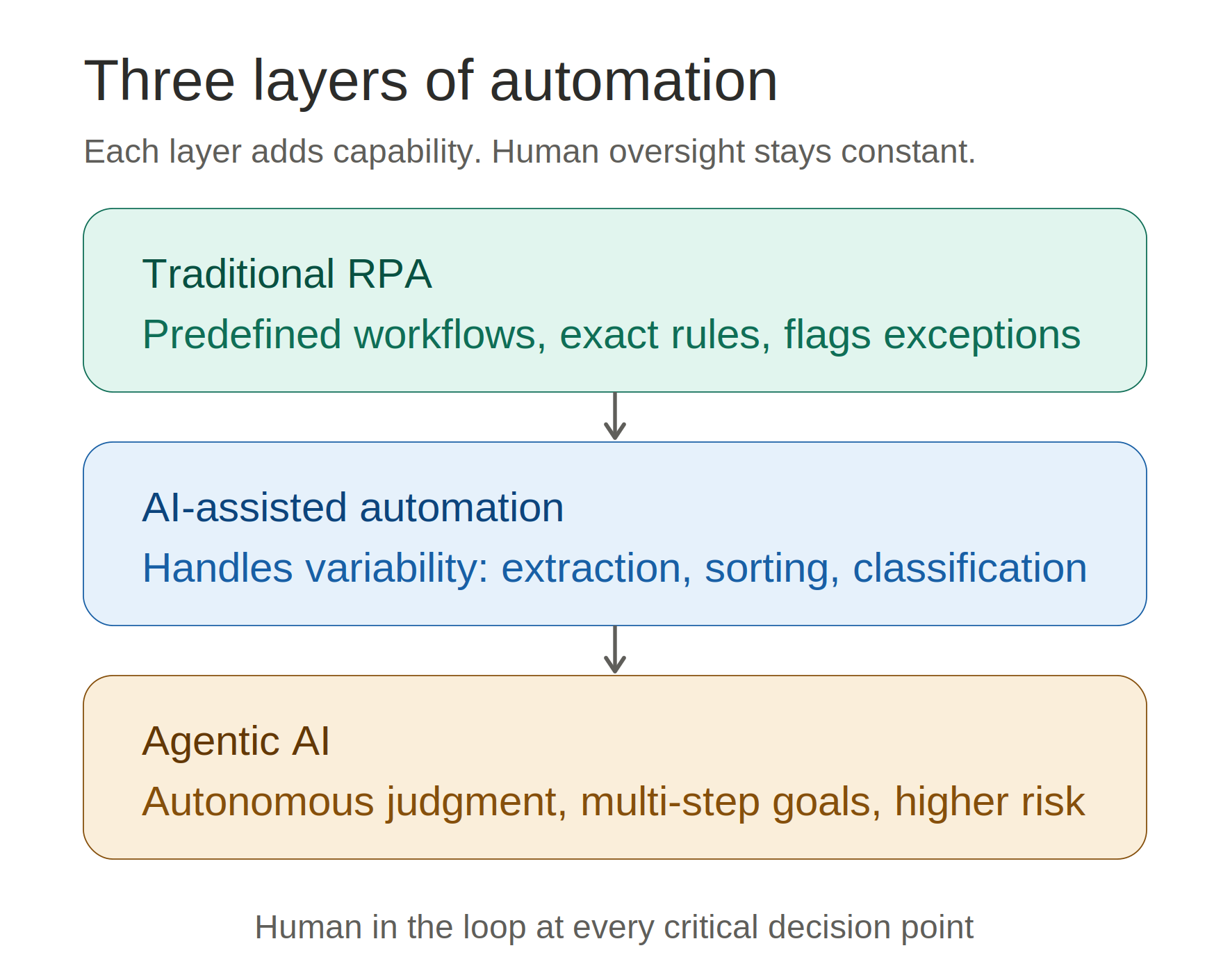
Traditional RPA executes predefined workflows. Every step is trained, every decision point is mapped. The bot follows the rules exactly as written. When it encounters something outside those rules, it stops and flags the exception for human review. This is predictable, auditable, and controllable.
AI-assisted automation adds an intelligence layer on top of RPA. It can handle variability that rules-based logic cannot, such as categorizing documents, extracting data from unstructured sources, or identifying which records are relevant to a specific property. The human still reviews and approves before anything critical moves forward.
Agentic AI goes further. It can navigate unfamiliar environments, make judgment calls without explicit instructions, and chain together multi-step actions based on a high-level goal rather than a detailed script. The appeal is obvious, but so is the risk.
Why Control Matters More Than Speed in This Industry
When an agentic system makes a wrong decision in a low-stakes context, the cost is usually small and recoverable. When it makes a wrong decision in a title insurance context, the downstream consequences can include claims, regulatory exposure, and reputational damage that can take years to repair.
Our clients are risk-averse by profession. They spent years making the case to their organizations that outsourcing some work was acceptable. Then they made the case that automation could be trusted alongside their teams. Asking them to take the next step to fully autonomous decision-making is asking them to accept a level of uncertainty the industry is not ready for.
There is also a practical consideration. With traditional RPA and AI-assisted workflows, when something breaks, we can identify exactly where in the flow the failure occurred and fix that component without touching the rest. With a heavily agentic system, a failure in the underlying AI provider or model can stop the entire workflow. That dependency risk is real, and it is not theoretical.
We are evaluating agentic AI in limited, controlled ways for specific processes where its adaptability makes a real difference. But we are not building fully autonomous title processing pipelines around it, because the industry is not there yet, and neither is the technology.
Where Agentic AI Goes in the Next Three to Five Years
Agentic AI will become more capable and more appropriate for regulated industries over time. The conversations happening at title industry conferences right now reflect a growing openness to automation that was not present three years ago. The question of whether AI will eventually handle more of the judgment layer in title processing is not a matter of if, but a matter of when.
Our current assessment is that meaningful autonomy in high-stakes title workflows is probably three to five years out, assuming continued improvement in the models and the development of better audit and traceability standards for agentic systems.
Until then, the right architecture keeps the human in the loop at the critical decision points, uses AI to reduce the work that reaches those decision points, and maintains enough control over the system to isolate and fix failures without taking down the entire workflow.
You can learn more about how we build and scope automation projects at TrueFocus Automation, including how we think about the build-versus-buy decision on our ROI calculator page.
The vendors promising fully autonomous title automation today are either working in lower-stakes parts of the process, or they are ahead of what the technology can actually deliver reliably. The goal is not to automate everything. The goal is to automate the right things, in the right way, with the right level of human oversight for where the industry actually is right now.
Jimmy Lewis is the CEO and Co-founder of TrueFocus Automation, a specialist in RPA and AI-driven workflow automation for the title insurance, mortgage, and real estate industries. TrueFocus has developed 840+ automation bots supporting more than 2,500 workflows and has returned over 1.3 million production hours to clients.