
Your Title Automation Isn’t Actually Automating Anything (And Here’s Why)


A mid-size title agency recently engaged us for an automation assessment. They’d invested in a new title production system that promised “built-in automation.” Six months post-implementation, they were frustrated. The system worked, but they weren’t seeing the efficiency gains they expected.
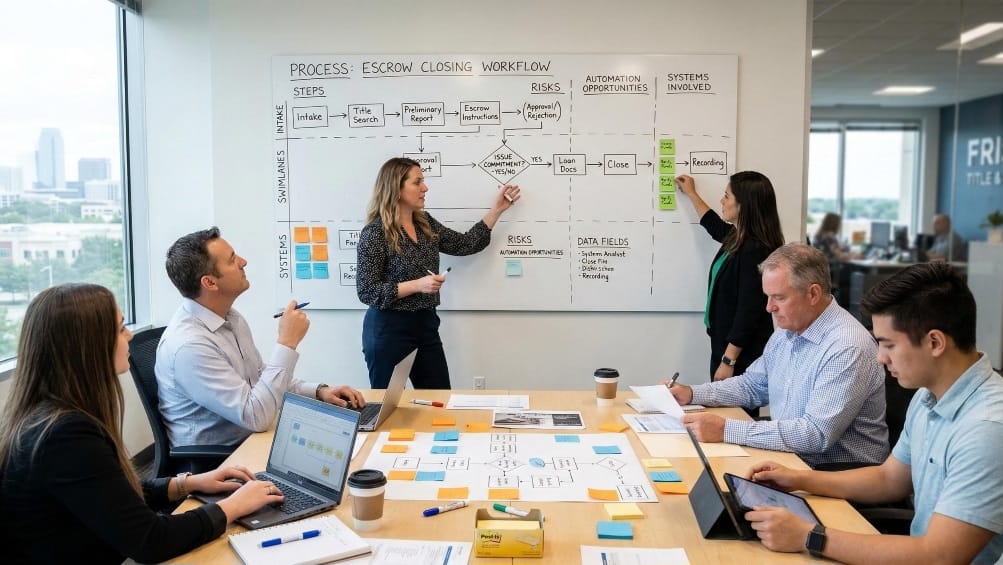
We shadowed their team on a couple of Zoom calls. The problem became obvious in the first hour.
The new system had great automation features. But between logging into the system and actually using those features, their staff was spending 15-20 minutes per file on manual work that the “automation” never touched.
This is the problem almost no one talks about: your title automation isn’t really automating anything. It’s automating steps within isolated systems while leaving the biggest time sinks completely untouched.
The In-Between Process Problem
Here’s what happens in most title operations:
You receive an order via email. Someone manually opens the attachment, reviews the information, logs into your title production system, creates a new order, manually keys in all the property details, assignee information, and transaction data. Then they save it, generate an order number, copy that number, go back to the email, send a confirmation reply with the order number, and update a tracking spreadsheet.
Total time: 15-20 minutes per order.
Now, your new title production system has an “automated order entry” feature. Great! Except it only works if the data is already in the system. Which it’s not. Because the data is in an email, or a web form, or a fax (yes, still), or a phone call.
So you’ve automated the last 30 seconds of the process and left the 15-minute manual grind completely unchanged.
In other words, that’s not automation. It’s a minor efficiency improvement wrapped in automation marketing.
Where the Real Time Sinks Are
Over time, after building automation for title companies since 2018, we’ve identified the processes that actually consume the most time. And almost none of them are the core title production steps.
The real time sinks are:
- Getting data from one system into another system
- Manual data entry from documents, emails, and phone calls
- Retrieving documents from county websites, tax sites, and third-party portals
- Generating reports by pulling data from multiple sources and formatting it manually
- Quality control reviews that involve checking data across multiple screens
- Status updates that require toggling between your production system, email, and client portals
Ultimately, these are the in-between processes. The steps your staff takes between the systems you’ve already invested in. And these are exactly what most “automation” vendors miss entirely.
Why Vendors Miss the In-Between Work
Most title technology vendors approach automation from a platform perspective. They’re selling you a better title production system, a better search platform, a better closing solution.
As a result, their automation features work within their platform. Order entry automation if you’re entering orders through their web interface. Search automation if you’re searching through their database. Reporting automation if all your data lives in their system.
However, title operations don’t work that way. You’re using a title production system from one vendor, pulling property data from county websites, checking liens through multiple portals, communicating with clients via email, and generating reports in Excel because that’s what your underwriter requires.
The vendors building those platforms don’t see the manual work happening between them. Because they’re not watching your staff actually do the work.
The Operational Expertise Difference
At TrueFocus, we come from operations. Before we built our first bot, we spent several years working in title insurance. Processing orders. Managing production teams. Dealing with the daily grind of moving data between systems that don’t talk to each other.
In short, we know the in-between work exists because we did the in-between work.
When we shadow a client’s team, we’re not looking at which features their production system has. We’re watching what happens before they even open that system. We’re timing how long it takes to pull documents from five different county websites. We’re counting how many times they copy and paste the same property address into different screens.
Ultimately, that’s where the automation opportunity actually lives.
Real Example: Hyperlinking
One of the first processes we automated for a client was hyperlinking. This wasn’t a sexy process or a cutting-edge technology application. Just a tedious, time-consuming task that was eating about 1,500 hours per month across teams supporting two states.
Here’s what they were doing manually:
For every title commitment, they needed to link each referenced document to the actual file stored on their shared drive. Open the commitment. Read the document description. Navigate to the file folder. Search for the document. Copy the file path. Paste it into the commitment. Repeat for every single document reference.
Typos broke the link. Missing documents stalled the process. It was being handled offshore because it was too tedious and error-prone to justify domestic labor costs.
We built a bot that:
- Reads the commitment automatically
- Identifies every document reference
- Searches the file structure
- Creates the hyperlinks
- Flags any missing or mismatched documents for manual review
Time savings: 90-95% of the manual work eliminated. Cost savings: more than 50% compared to the offshore solution. Accuracy improvement: near-zero typos (exception processing handled by humans), no broken links.
In contrast, that’s real automation. Not “we have a feature that could help with this if you restructured your entire document management system.” Just solving the actual problem within the systems they already have.
The Integration Layer That Actually Matters
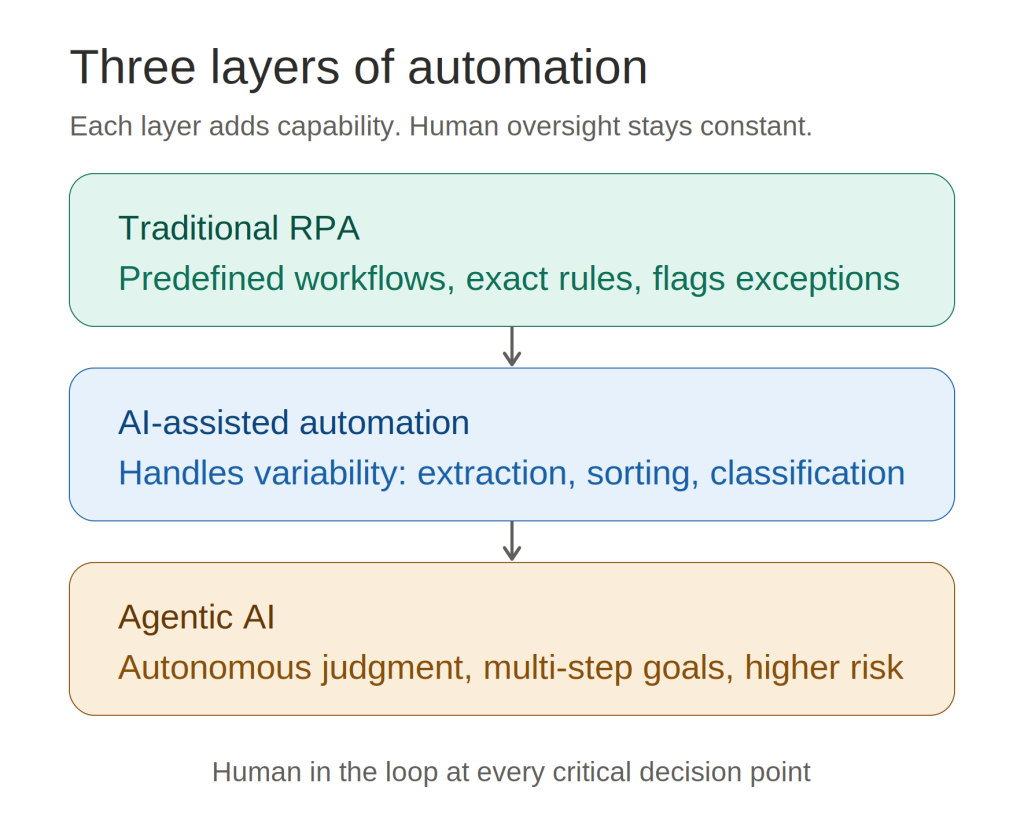
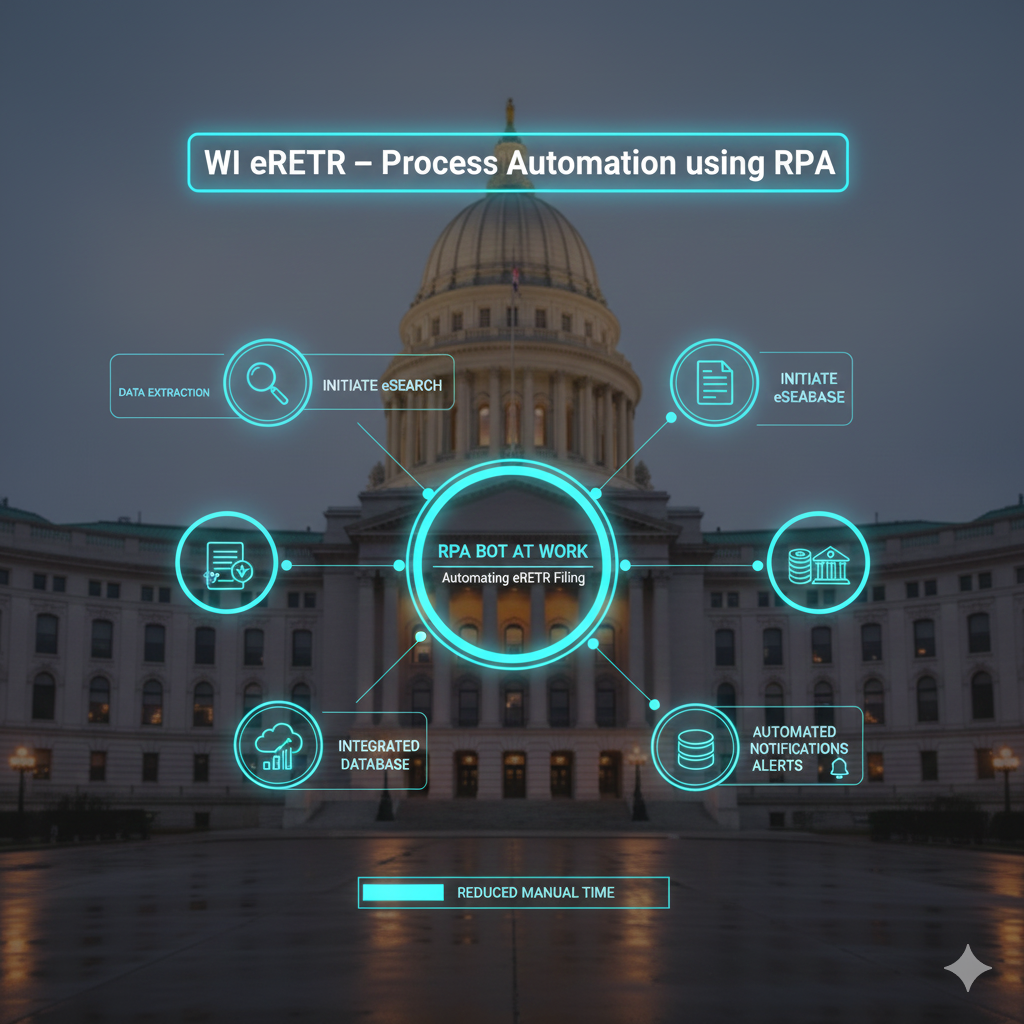
When we talk about RPA (Robotic Process Automation), we’re really talking about building an integration layer that works the way your staff currently works.
Your staff logs into multiple systems. The bot logs into multiple systems.
Your staff navigates through web pages, clicks buttons, enters data, retrieves information. The bot does the same thing, just faster and without typos.
Your staff checks for exceptions, flags issues, routes work to the right person. The bot does the same, using the same business rules your staff already follows.
Importantly, this isn’t replacing your systems. It’s automating the manual work that happens between your systems.
What This Means for Your Title Automation Strategy
So, if you’re evaluating automation vendors and they’re only talking about features within their platform, you may be looking at the wrong vendors.
The questions you should be asking:
- Can you automate work that spans multiple systems we’re already using?
- Can you retrieve data from county websites, third-party portals, and email?
- Can you integrate with our legacy systems without requiring a complete platform replacement?
- Can you handle exceptions and route them to our staff for review?
If the answer to any of those questions is “no” or “you’d need to change how you’re working first,” they’re selling you a platform, not automation.
The Path Forward
Real automation solves the problems you’re actually having, with the systems you’re actually using, in the workflows you’re actually running.
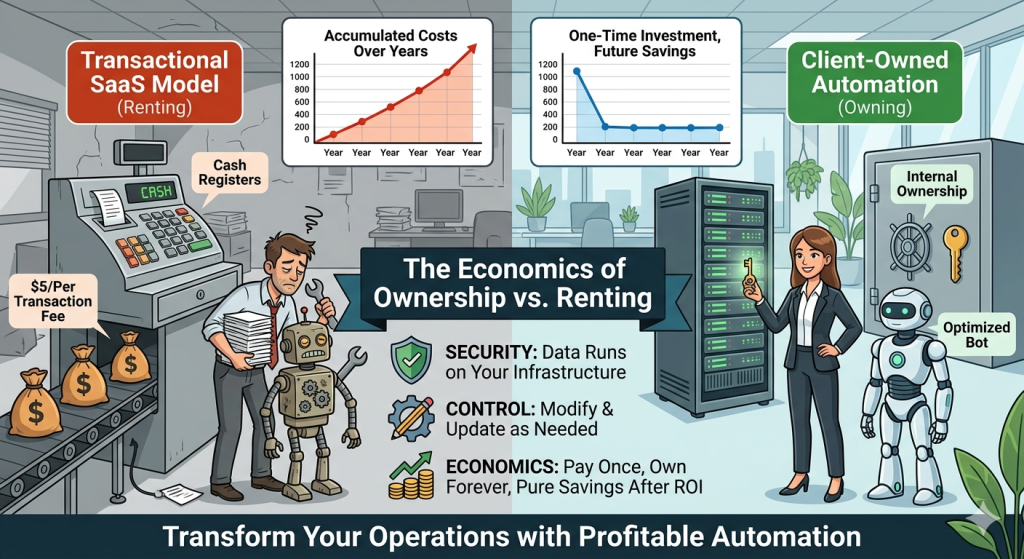
It doesn’t require you to rip out your title production system and replace it with something new. It doesn’t force you to restructure your entire operation around a vendor’s preferred workflow. It works with what you have, and it automates the manual grind in between.
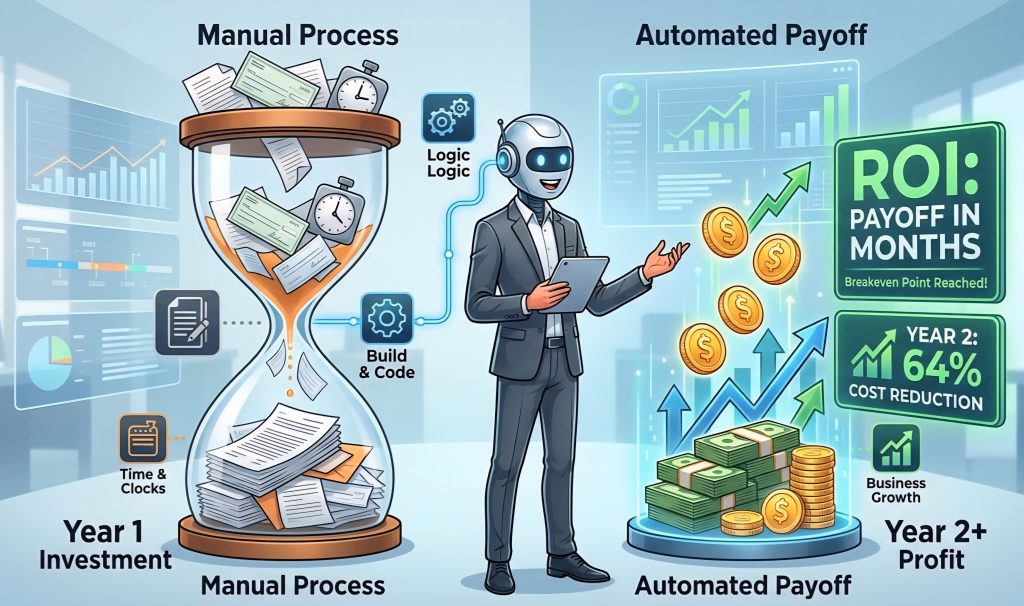
That’s what operations-first automation looks like. And that’s what actually delivers ROI in weeks or months instead of years.
Want to identify the in-between processes that are actually consuming your team’s time? Contact us at info@truefocusautomation.com. We’ll shadow your workflow, identify the real time sinks, and show you exactly where automation can deliver measurable results.