
Why Most Automation Projects Take Years to Pay Off (And Why Yours Shouldn’t)

Last year, we engaged with a title company that was considering automation. One vendor had quoted nearly $200,000 for implementation with a projected four-year ROI.
Their immediate reaction was simple: “Is that really what enterprise automation costs?”
The honest answer is no. It doesn’t have to.
A Quick ROI Comparison
Typical Enterprise Automation (starting with multiple processes)
-
- Cost: $200,000+
- Time to value: 18–24 months
- ROI: 3–4 years
Lean Automation Approach (start with 1 process)
-
- Average bot cost: ~$9,500
- Deployment: 4–6 weeks
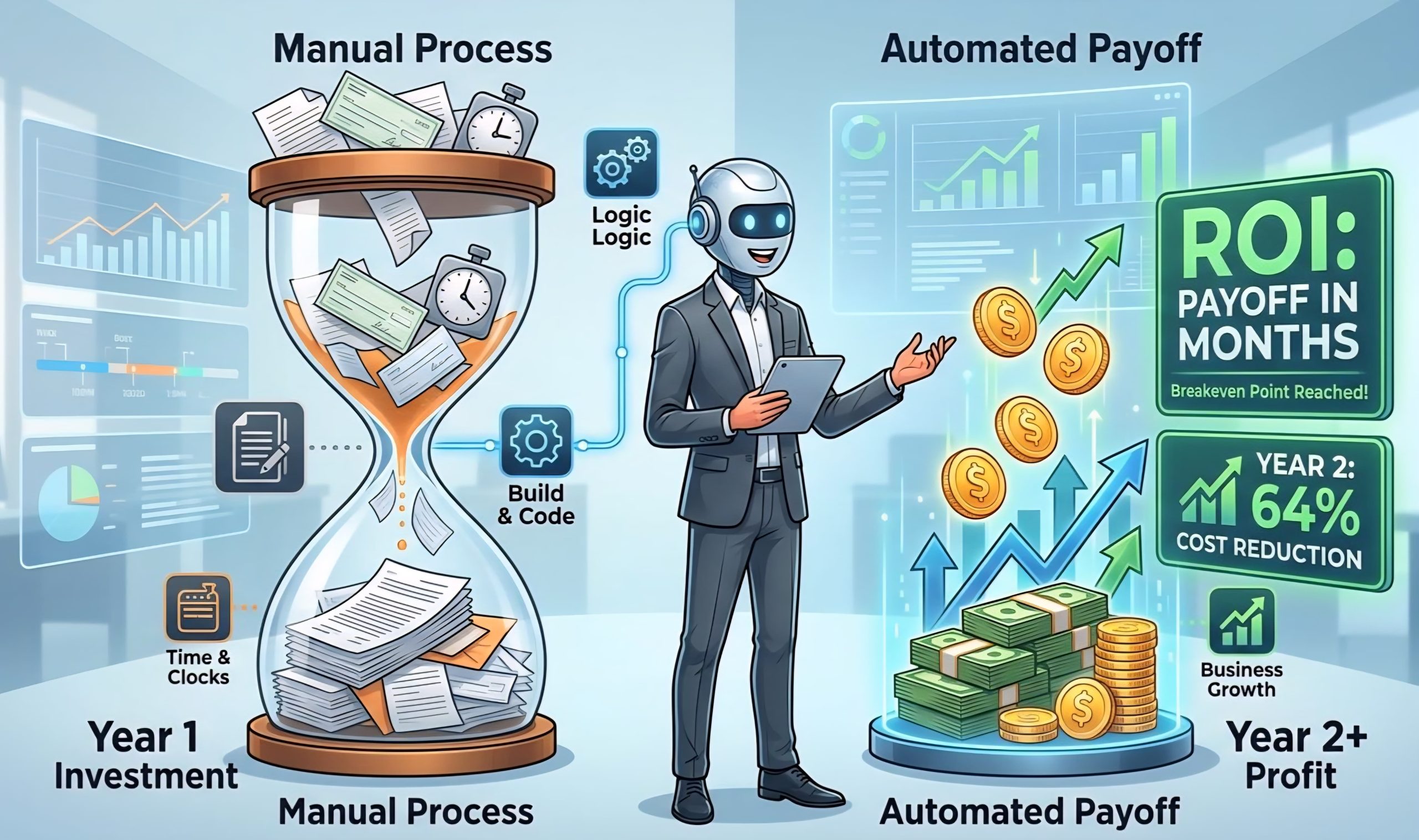
- Average ROI: 2–6 months
The difference isn’t about cutting corners. It’s about focusing automation on the right processes first.
Most title companies aren’t struggling because they lack good people. They’re struggling because good people are spending too much time on repetitive tasks like re-keying order data, chasing documents, and updating multiple systems.
Automation works best when it removes that invisible operational drag.
How Traditional Automation Projects Get Expensive
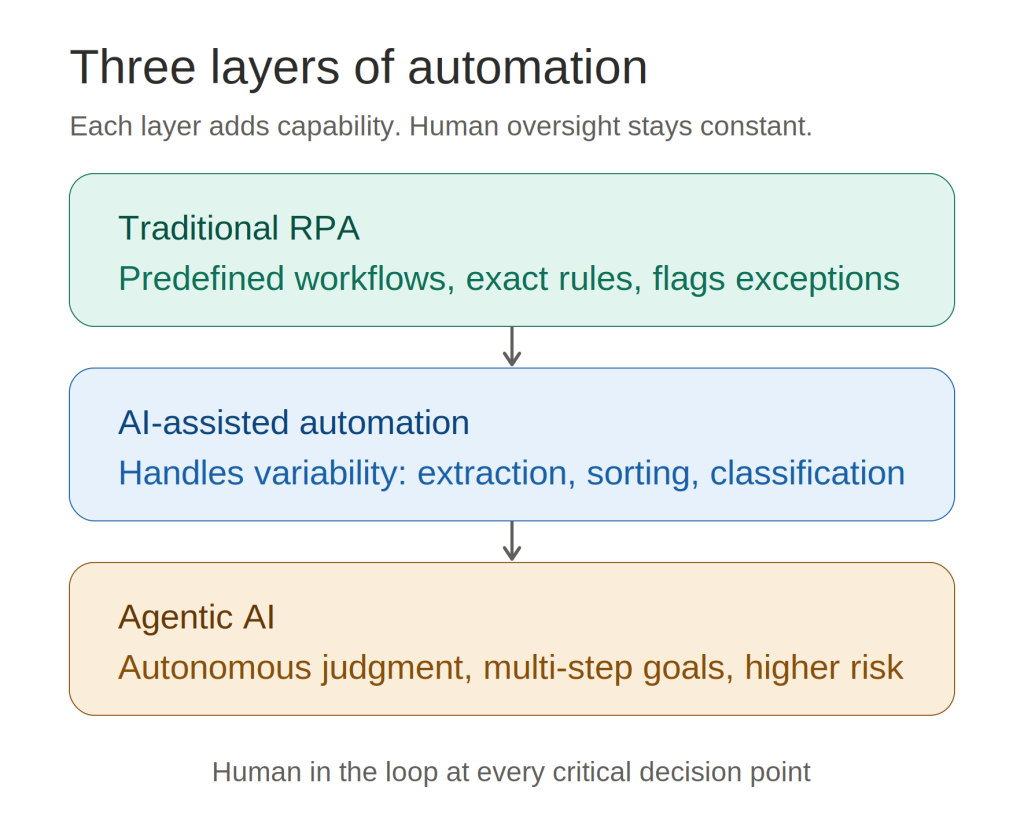
Somewhere along the way, the automation industry started convincing companies that transformation requires massive upfront investment, lengthy implementations, and multi-year payback periods.
Here’s what that typical approach often looks like:
-
- Six-month discovery and planning phase
- Six months of development
- Three months of testing and refinement
- Expensive enterprise software licenses
- Dedicated IT resources for deployment
- Complex change management programs
Result
Total timeline: 18–24 months before seeing value
Total cost: often $200K+
And the promised ROI?
“Don’t worry. You’ll break even in three to four years.”
There’s a Faster Way
There’s another way to approach automation. One that focuses on speed, practicality, and measurable results.
At TrueFocus, our average client sees ROI in 2–6 months. Not because we cut corners, but because we focus on what actually drives results.
1. Start Small and Specific
Instead of trying to automate an entire operation at once, we begin with two or three high-impact processes. Typically, the ones that:
-
- Consume the most manual hours
- Have clear, repeatable steps (mature process)
- Produce immediate, measurable savings
Automate those first. Prove the value. Then expand.
2. Build for Your Systems, Not Ours
We don’t force companies to replace their title production system or completely restructure their workflows.
Instead, we build bots that work with what you already have. Legacy systems, web portals, spreadsheets, PDFs, and the tools your team actually uses every day.
That means faster deployment and significantly lower costs.
3. Keep Development Lean
Our average bot costs about $9,500, not $25,000 or $50,000.
Most automation projects can be designed, built, tested, and deployed in 4 to 6 weeks.
Why the difference? Our team approaches automation like operators who learned to code, not consultants billing by the hour.
Case Study: One Bot Replaced 66 Hours of Manual Work Per Week
One of our clients was manually entering data for every new order. Staff would pull information from emails, contracts, and external portals, then manually key everything into their title production system.
Before Automation
-
- Manual process time: 15–20 minutes per order
- Volume: 200 orders per week
- Annual labor cost: ~$83,000
What the Bot Does
-
- Monitors incoming emails and web submissions
- Extracts order information automatically
- Populates the title production system
- Flags exceptions for human review
Project Details
-
- Development cost: $12,000
- Development time: 6 weeks
Results
-
- Year 1 savings: ~$58,000 after automation costs
- Year 2 savings: ~$70,000
- Payback period: ~2.5 months
- First-year ROI: ~500%
This isn’t projected ROI. It’s real operational savings.
Why the Per-Bot Cost Matters
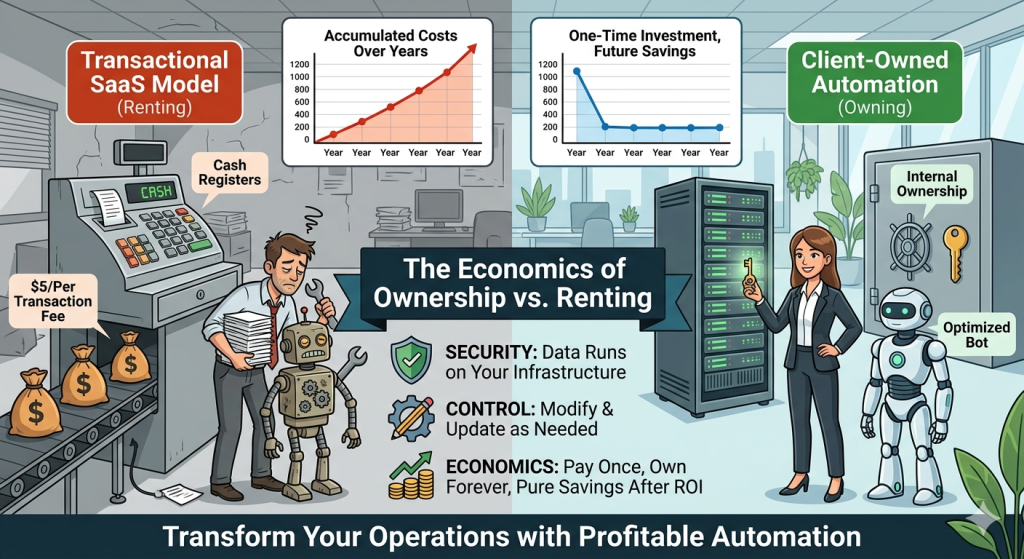
When automation costs $25,000 – $50,000 per process, ROI takes years because the project is front-loaded with massive costs.
At $10,000 per bot, the math changes completely.
If a bot saves $2,000 per month, the investment pays for itself in about six months. Most of our bots generate significantly more savings than that, especially when applied to core title production workflows.
The Expansion Effect
After clients see ROI from their first few bots, something interesting happens.
They expand automation across their organization.
Why? Because now they know:
-
- The development process is straightforward
- The bots work reliably in production
- The ROI is real and measurable
- Automation can scale across their operation
We’ve had clients start with a few bots and expand to 25 or more automations over 2-3 years, with each one paying for itself in months rather than years.
What About Maintenance?
This is one of the most common questions we hear:
“What does it cost to maintain the bots?”
For client-owned automation, maintenance is typically minimal. Systems change, websites update, and processes evolve, but ongoing support is usually limited to:
-
- Around $500 per month per bot for support and monitoring
- A few thousand dollars per year for occasional change requests
Not $5K–$10K per month in recurring SaaS fees. In most cases, the automation saves far more in labor than the ongoing support ever costs.
The Real Cost of Waiting
Title companies often say they’ll automate “when things slow down” or “when more budget is available.”
But waiting has a real cost.
If automation could save your company $100,000 per year, every year you delay costs you $100,000 in lost savings.
And the longer manual processes stay in place, the further ahead your automated competitors get.
Automation should remove friction from your operation, not introduce a two-year project.
The ROI clock starts when you implement, not when you decide to explore it.
Our Approach: Prove It First
We encourage clients to start small.
-
- Identify one or two processes with clear, measurable costs
- Build and deploy the automation
- Measure the real results
- Then decide if you want to expand
No massive commitments. No multi-year contracts. Just prove the value quickly and scale from there.
One Question to Consider
If we could automate the one task that currently causes the most ‘burnout’ or turnover in your office, which would it be?
That’s usually the best place to start automation.
If you’d like help identifying a few processes that could deliver fast ROI, feel free to reach out at info@truefocusautomation.com.