
The Case for Client-Owned Automation: Why Ownership Models Matter More Than You Think

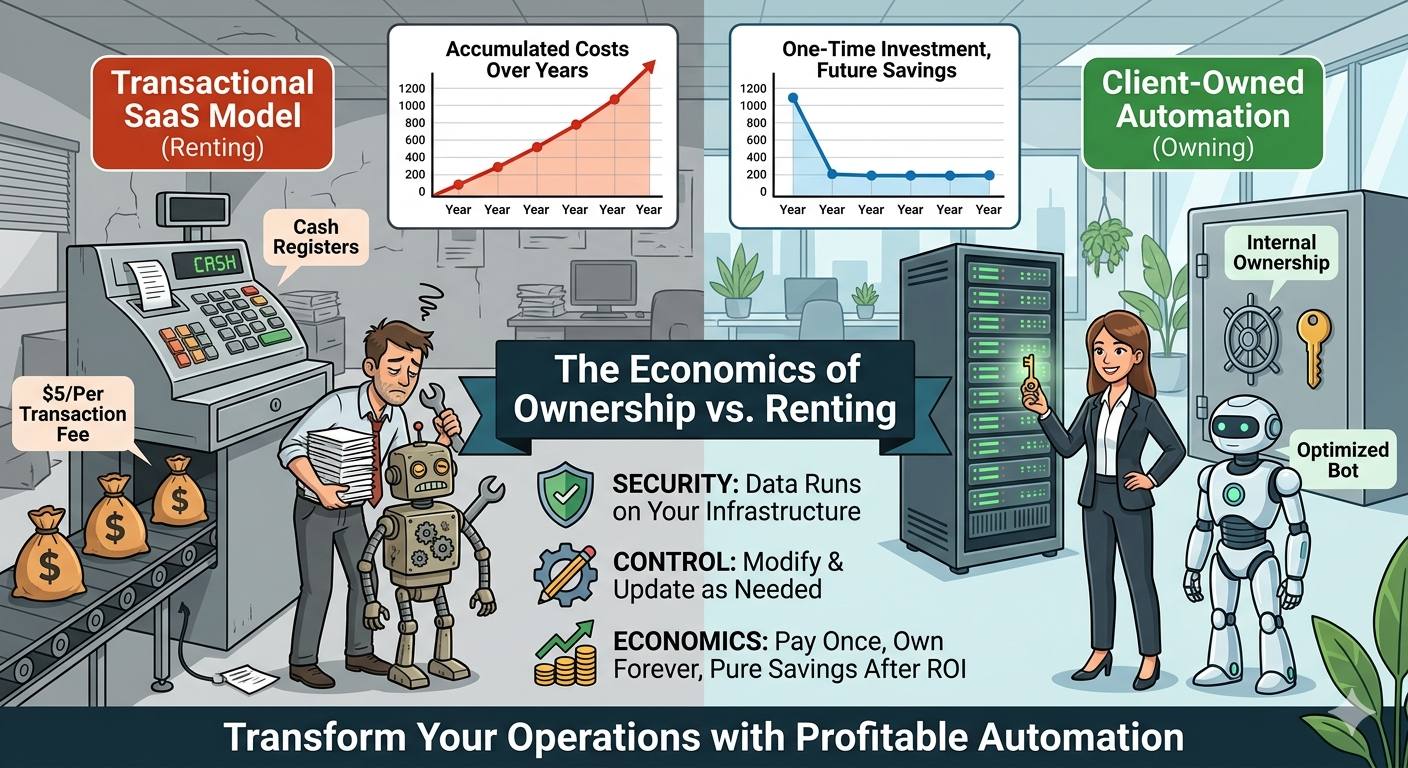
Here’s a conversation we often have: A title company reaches out, frustrated with their current automation partner or options. The bots work fine. The problem? They’re paying a ton per month in transaction fees for automation they’ve been using for years and for software they don’t own and can’t control.
The SaaS Trap
Don’t get me wrong, SaaS models work great for many applications. But when it comes to critical operational automation, the economics tell a different story.
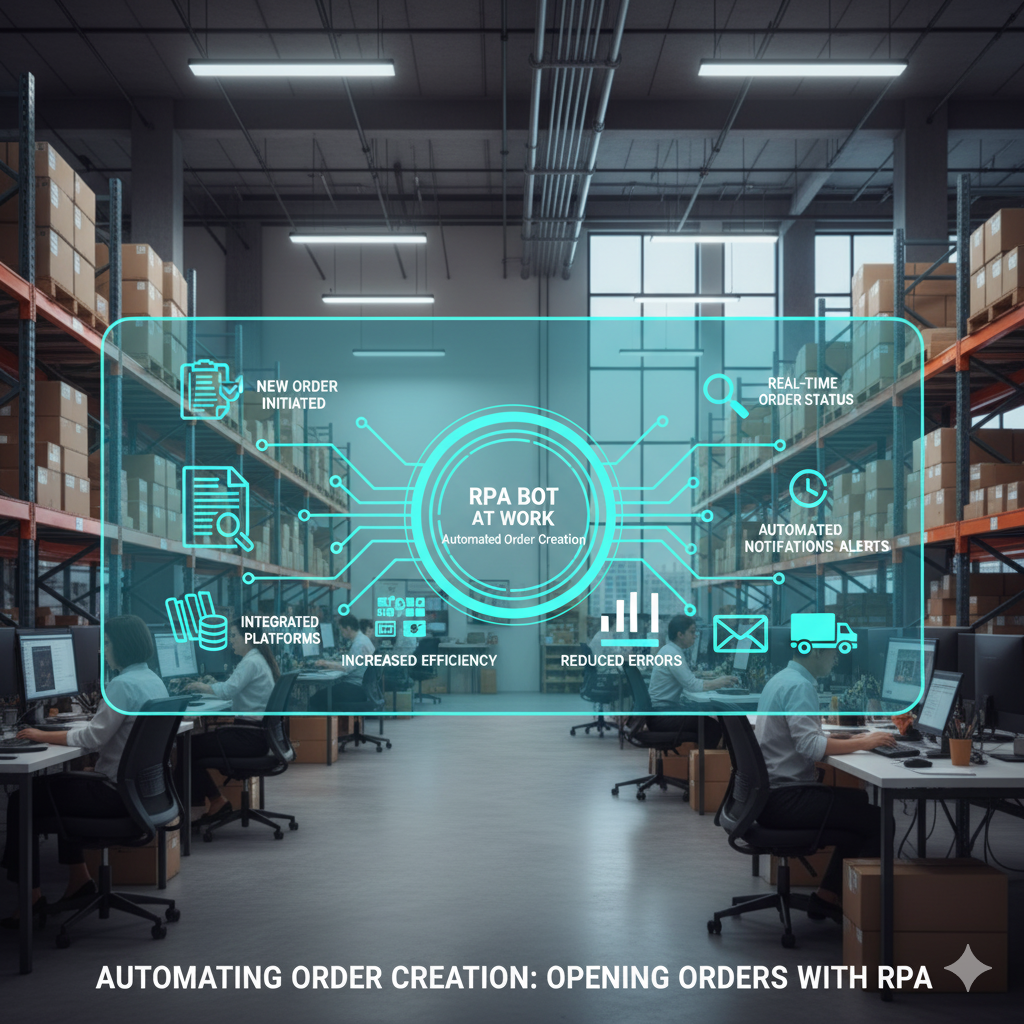
Let’s say you automate your order entry process. Your vendor builds the bot, hosts it on their servers, and charges you per $5/per transaction. Sounds reasonable, right? You’re paying as you go, scaling with your volume.
But here’s what actually happens:
- Year One: You’re paying $5,000/month for a bot that processes 1,000 orders
- Year Two: Same bot, same 1,000 orders, still $5,000/month
- Year Three: Still paying, still the same bot, no improvements
- You’ve paid a total of $180,000 for code you don’t own
Meanwhile, the vendor moves on to their next client. That bot you’ve been funding for years? You can’t modify it, you can’t optimize it, and if you leave, you start from scratch.
Client Ownership Changes Everything
At TrueFocus, we offer both models, but here’s what sets us apart: we give clients the option to own what we build.
When you own your automation:
- Security: The bot runs on your infrastructure. Your data never leaves your environment.
- Control: Need to modify the process? Update the workflow? You can quickly implement change requests since you own the code.
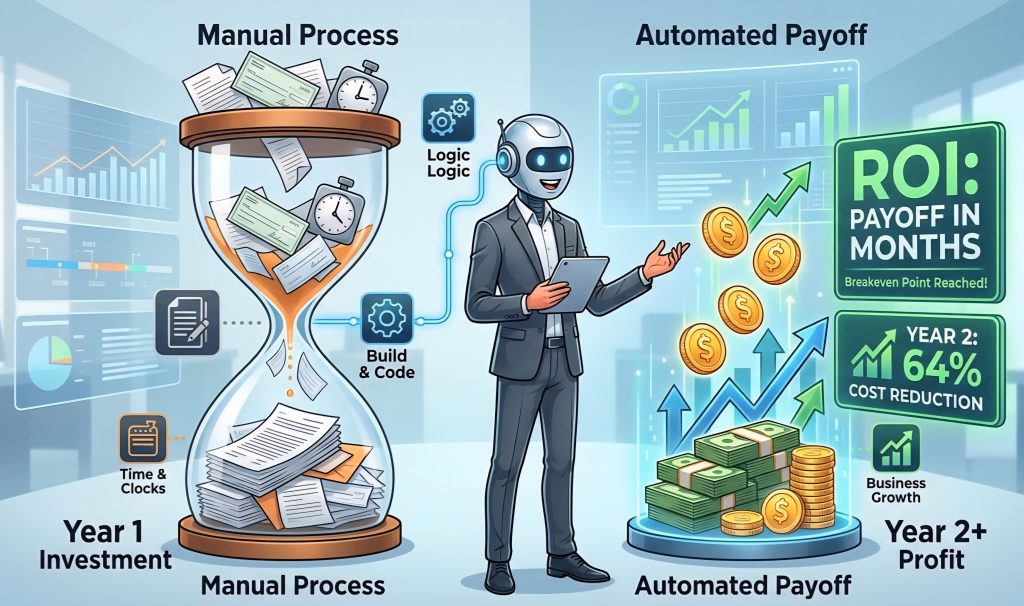
- Economics: Pay once, own forever. After your ROI period (typically 6-12 months), every transaction is pure savings.
- Flexibility: Want us to manage it? Great. Want to bring it in-house? That works too.
Real Numbers That Matter
To illustrate the financial impact of practical automation, consider this example. We automated a process that monitored a decrypted email inbox, extracted key details and attachments from those emails, and transferred that into the client’s title production system to update the title order. The client processed about 25,000 orders per year from a key lending client. Each order previously required roughly four minutes of manual effort from a staff member earning $30/hour (fully loaded cost).
That equates to about 1,667 labor hours annually, or $50,000 per year in manual processing cost.
The automation investment included a one-time bot development fee of $6,640, plus ongoing annual costs of $8,800 for licensing, hosting, and vendor support. Even with full support included, the numbers were compelling:
- Year 1 ROI: ~224%; Year 1 Net Savings: $34,560 ($50,000 − $15,440)
- Year 2 ROI: ~468%; Year 2 Net Savings: $41,200 ($50,000 − $8,800)
- Year 3 ROI: ~468%; Year 3 Net Savings: $41,200 ($50,000 − $8,800)
- 3-Year ROI: ~354%; 3-Year Net Savings: $116,960 ($150,000 – $33,040)
The company eliminated more than 1,600 hours of repetitive work each year and achieved a payback period of approximately 2-3 months.
This is what effective automation looks like in practice. It is not about replacing people. It is about removing low-value, repetitive tasks so teams can focus on work that actually moves the business forward.
When SaaS Makes Sense
I’m not saying transactional models never work. Sometimes they do:
- You’re testing automation for the first time and want to minimize upfront investment
- The process is highly variable and might change significantly
- You don’t have IT infrastructure to host the solution
But for core, repetitive processes that you’ll run for years? Ownership is almost always the better long-term play.
The Hybrid Approach
Here’s what we typically recommend: Start with a few high-value processes using our client-owned model. Prove the ROI quickly. Then decide if you want to expand with more owned bots or supplement with transactional solutions for variable workflows.
Many of our clients start with 2-3 owned bots, see the results, and come back for more. Because once you’ve experienced the economics of ownership, it’s hard to go back to paying monthly fees forever.
What About Enterprise Companies?
This conversation becomes even more important at scale. We work with some of the largest title operations in the country. At their volume, transactional fees would be astronomical.
But it’s not just about the money. Enterprise companies have security requirements, compliance needs, higher staff turnover, and integration complexities that make client ownership not just preferable, but essential.
The Real Question
The question isn’t whether you should automate. That decision is already made for you by market pressures and margin compression.
The real question is: Do you want to rent automation forever, or own the technology that’s transforming your operations?
At TrueFocus, we build both models. But after seven years and hundreds of deployments, the clients who own their automation are the ones who scale fastest and save the most.
Want to discuss which model makes sense for your operation? Contact us at info@truefocusautomation.com. We’ll walk through the economics based on your actual processes and volume.