
The SaaS Trap: What Happens After Two Years of “Pay Per Transaction”

We recently had an interesting conversation with a long-term client now evaluating RPA automation SaaS vs ownership cost. They’ve been using one of our bots on a transactional model for two years. Great relationship, the bot works flawlessly, they’re happy with the results.
Then they asked the question we knew was coming: “What would it cost to just buy the code outright?”
The Two-Year Wake-Up Call
This conversation happens more often than you’d think. A title company starts with a SaaS automation solution. Low upfront cost, pay as you go, seems like a smart move. The bot works. Volume stays steady. And month after month, they keep paying. Then someone in finance does the math.
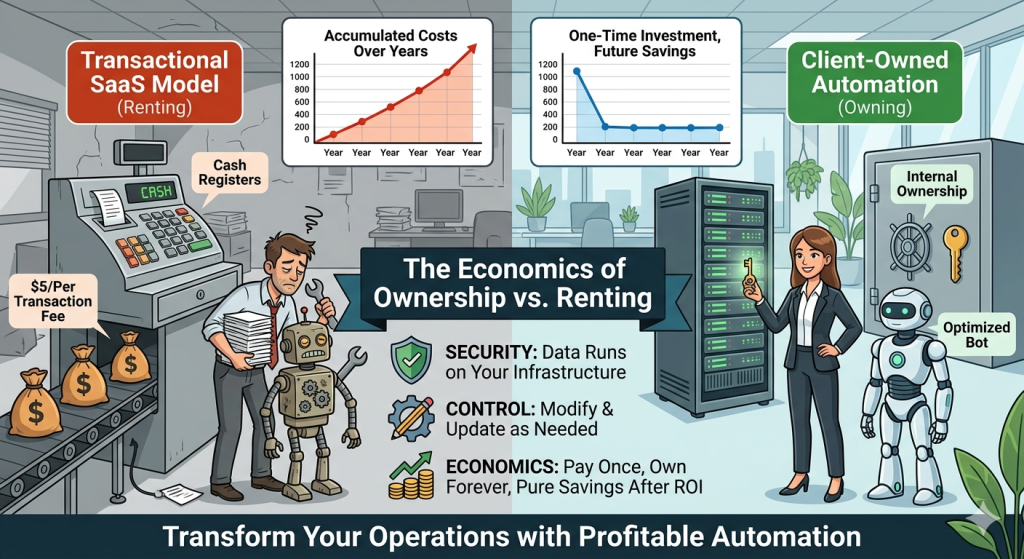
Two years of transactional fees at $5-8 per order adds up. For a mid-size operation processing 1,000 orders monthly, that’s $120,000 to $192,000 paid over 24 months. For code they don’t own. For a process that hasn’t changed. For a bot that was built once and has been running the same way ever since.
Independent research backs this up. According to Blueprint’s annual automation study, U.S. organizations spend an average of $600,000 per year on RPA, much of it on recurring fees for processes they do not own. Blueprint’s annual automation study
The Real Cost of “Low Risk”
SaaS models are positioned as low-risk. No big upfront investment. Cancel anytime. Scale up or down with your volume. And for some use cases, that makes perfect sense.
But here’s what the sales pitch doesn’t tell you:
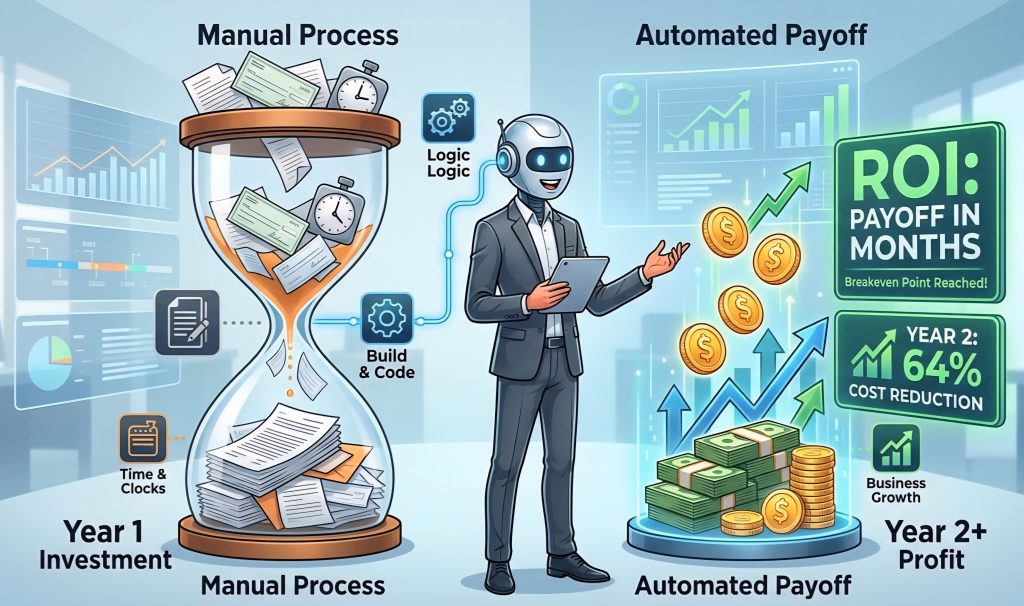
Year One: You’re paying $8,000/month for a bot that automates order entry. Annual cost: $96,000. The automation works great. You’re saving labor costs, improving accuracy, getting faster turnaround times.
Year Two: Same bot. Same process. Same $8,000/month. Annual cost: $96,000. You’ve now paid $192,000 total.
Year Three: Still paying. Still $8,000/month. Cumulative investment: $288,000.
Industry analysts at HFS Research note that licensing fees represent only 25 to 30% of the true total cost of RPA ownership, meaning the ongoing expense runs even deeper than the transaction fees alone. total cost of RPA ownership
At what point does this stop being a “low-risk” model and start being an expensive ongoing obligation?
What We Tell Clients
When clients ask us about buying out their SaaS arrangement, we’re transparent about the pricing. We typically settle on 2 to 3x the original build price.
Why the multiplier? Because we took on the risk to build, support, and optimize the bot on our dollar. We maintained it. We handled exceptions. We absorbed the hosting costs. That has value.
But here’s the thing: even at 2-3x the build price, clients usually jump at it. Because they realize what they’ve already spent, and more importantly, what they’ll continue to spend if they don’t own the solution.
A bot that originally would have cost $15,000 to build might be $30,000 to acquire after two years of SaaS usage. Sounds expensive until you realize you’ve already paid $96,000 and you’re on track to pay another $48,000 in the next six months alone.
The acquisition fee becomes the breakeven point. After that, every transaction is pure savings.
The “Success Tax” Problem
Here’s another issue with transactional models: they penalize your growth.
Your business is doing well. Volume doubles. Congratulations! Your automation bill also just doubled.
With a client-owned model, if your volume doubles, your automation costs stay flat. The bot doesn’t care if it processes 500 orders or 5,000. It just runs.
SaaS vendors call this “scaling with your business.” We call it a success tax.
When RPA Automation SaaS vs Ownership Makes Sense
I’m not saying transactional models are always wrong. Sometimes they’re the right choice:
Testing a new process: You’re not sure if the automation will work long-term. Pay per transaction while you validate the approach.
Highly variable volume: Your order volume swings wildly month to month. Paying for actual usage makes sense.
Limited IT infrastructure: You don’t have servers to host the solution and don’t want to invest in cloud infrastructure.
Short-term need: You’re automating something for a specific project or time period, not a permanent operational process.
But for core, stable processes you’ll run for years? Economics almost always favors ownership.
The Question You Should Ask
If you’re evaluating automation vendors, here’s the question that matters:
“If I use your SaaS model for two years, what would it cost to acquire ownership of the code at that point?”
If the vendor won’t give you a straight answer, or if the buyout price is astronomical, you’re not using a flexible SaaS model. You’re renting software with no exit strategy.
Our Approach to Automation Saas vs. Ownership
At TrueFocus, we offer both models because different clients have different needs. But we’re always upfront about the long-term economics.
Want to start with SaaS? Great. Here’s the monthly cost, here’s the buyout option, here’s the timeline where ownership becomes the better investment.
Want to own from day one? Here’s the build cost, here’s the annual maintenance estimate, here’s your breakeven timeline based on current volume.
No surprises. No games. Just real numbers so you can make an informed decision.
The Bottom Line
There’s nothing inherently wrong with SaaS automation models. But after two years of steady volume, the math usually stops making sense.
Most of our clients who started with transactional pricing eventually convert to ownership. Because once you see what you’ve spent over 18-24 months, the acquisition cost looks like a bargain.
The real question isn’t whether to use SaaS or buy. It’s whether your vendor gives you the option to switch when the economics change.
Frequently Asked Questions
What is the difference between SaaS RPA and owning automation code? With a SaaS or transactional RPA model, you pay a recurring fee per order or per month and do not own the underlying code. With an ownership model, you pay a one-time build cost and own the bot outright, with no ongoing usage fees tied to volume.
When does it make financial sense to buy RPA automation instead of using SaaS? For stable, high-volume processes running longer than 12 to 18 months, ownership almost always has a lower total cost. A company processing 1,000 orders per month at $6 per order will spend over $144,000 in two years on a solution they do not own.
Can you buy out a SaaS RPA contract and take ownership of the code? Yes, many RPA providers including TrueFocus Automation offer a buyout option. The acquisition price is typically 2 to 3 times the original build cost, which in most cases is still significantly less than continuing to pay transactional fees.
What is a “success tax” in automation pricing? A success tax refers to the way transactional SaaS models increase your costs as your business grows. If your order volume doubles, your automation bill doubles too. With a client-owned bot, volume increases have no impact on your automation cost.
Evaluating automation models and want to see the real numbers? Contact us at info@truefocusautomation.com. We’ll walk through both approaches based on your actual volume and show you exactly where the breakeven happens.
If you’d like help understanding RPA automation SaaS vs ownership cost reach out to us at info@truefocusautomation.com to start a conversation.
Toggle title
Toggle content goes here, click edit button to change this text.